


You place a bet, the multiplier starts rising, and the game crashes just before you cash out.
Or you spin a slot several times, lose repeatedly, and start wondering:
Did the casino change the result because I was winning?
It is one of the most common suspicions in online gaming.
The short answer is more complicated than a simple yes or no.
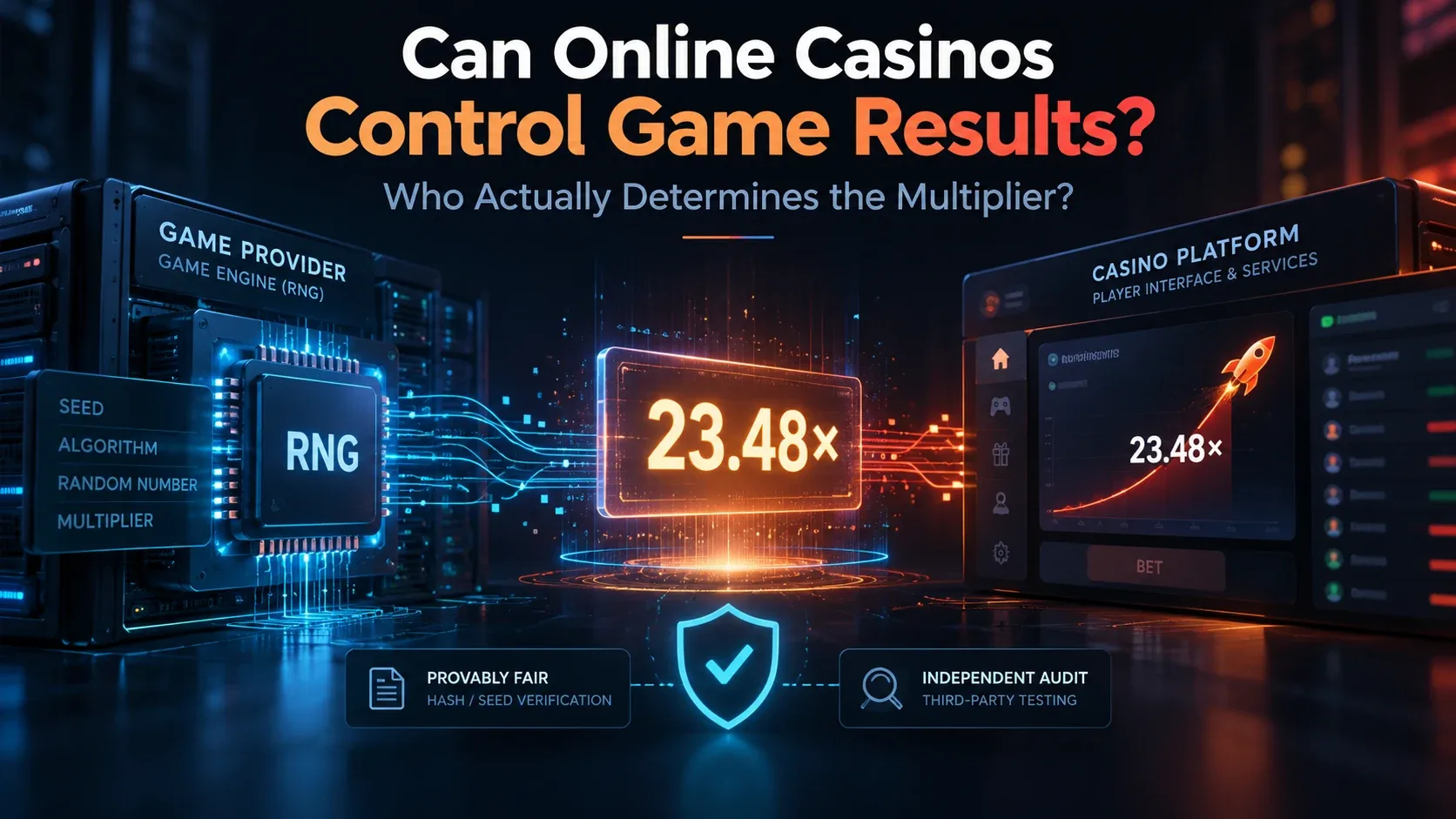
On a legitimate game supplied through a regulated gaming system, the casino website normally does not manually decide the result of each individual round. Game outcomes are usually generated according to the game software, its mathematical model, and systems such as a Random Number Generator (RNG) or Provably Fair mechanism.
However, the casino operator, game provider and gaming platform are different parts of the system — and understanding that difference is important.
This guide explains who actually controls what.
Casino Operator vs Game Provider: They Are Not the Same Thing
When you open an online casino, everything may look like it belongs to one company.
Your account, balance, deposits, bonuses and games are all shown inside the same website.
But technically, several different systems may be involved.
A typical setup can look like this:
Player → Casino Platform → Game Provider → Game Server / RNG → Result
The casino operator may be responsible for:
- account registration
- deposits and withdrawals
- KYC verification
- bonuses and promotions
- responsible-gaming tools
- customer support
- deciding which games appear in its lobby
The game provider may be responsible for:
- game software
- mathematical rules
- payout structure
- RNG or result-generation system
- game server
- round history
- fairness or verification systems
This is why the same game can appear on many completely different casino websites.
The casino provides access to the game, but it may not be the company that created or operates the underlying game engine.
Who Determines the Result of an RNG Game?
Many online casino games rely on a Random Number Generator, commonly called an RNG.
An RNG produces values that are then converted or mapped into game outcomes.
For example, an RNG output could eventually determine:
- which slot symbols appear
- which number is selected
- which card is dealt
- whether a Mines tile is safe
- where a Plinko result lands
- another random game event
For legitimate regulated gambling software, the RNG and game logic are expected to operate according to the published game rules and underlying mathematical model.
So in a properly implemented regulated game, the normal model is not:
Casino employee sees your bet → chooses whether you win.
It is closer to:
Game system receives the wager → game logic generates or determines the result → result is returned to the player.
Can a Casino Change the Result After You Bet?
Under legitimate gaming systems, secretly changing the game rules, payout probabilities or result-generation behaviour for one player is not how the game is supposed to operate.
That means the normal model should not look like this:
“This player just won ₹20,000, so reduce their next-round odds.”
or:
“This player deposited more money, so make the next crash happen earlier.”
That would be very different from a game simply producing an unfavourable random outcome.
The important qualification is legitimate gaming system.
A fake casino, cloned game, manipulated APK or unregulated imitation may not follow the same standards at all.
Then Why Does It Sometimes Feel Like the Casino Knows When I Bet?
Randomness can create patterns that feel personal even when they are not.
Imagine a crash game.
You watch several rounds without betting:
4.8x7.2x2.9x11.6x
Then you finally place a bet.
The next round crashes at 1.07x.
From the player's perspective, it can feel like:
“The moment I entered, the game changed.”
But previous rounds do not necessarily tell you what the next result will be.
Random systems naturally produce:
- losing streaks
- winning streaks
- repeated low outcomes
- unusually high outcomes
- clusters that look suspicious
Humans are extremely good at finding patterns, even in data generated randomly.
A bad sequence alone is not evidence that the operator personally altered your result.
Can the Casino Change RTP?
This requires a more careful answer.
RTP and individual-round manipulation are not the same thing.
RTP — Return to Player — is the theoretical long-run percentage built into a game or game configuration.
A 97% theoretical RTP does not mean:
Bet ₹100 → receive ₹97.
It describes expected long-run mathematics across a very large amount of play.
Short sessions can perform far above or far below the theoretical RTP.
Different games — and in some cases different approved versions or configurations of a game — can also have different mathematical settings.
So an operator may sometimes offer one approved game configuration rather than another where the game provider and applicable rules allow it.
That is very different from secretly lowering one player's personal odds while that person is playing.
Who Determines a Crash Game Multiplier?
Crash games require another distinction.
The visible multiplier is not usually someone at the casino manually pressing a button and deciding when the graph stops.
The exact result-generation method depends on the game.
Some crash games may rely on conventional RNG architecture.
Others use cryptographic Provably Fair systems.
A Provably Fair game is designed so that players can verify completed results using cryptographic information rather than simply trusting a claim that the game was fair.
SPRIBE Aviator Is a Useful Example
SPRIBE Aviator is a useful example because the game uses a documented Provably Fair system.
The casino where you access Aviator may control:
- your account
- wallet
- deposit methods
- bonuses
- withdrawals
- customer service
But the actual Aviator game is supplied by SPRIBE.
That helps illustrate an important distinction:
game fairness and platform trust are two separate questions.
A genuine game can exist on a platform with poor customer service.
And a professional-looking casino website could theoretically display an imitation game that is not the genuine provider version.
What About Mines?
Mines uses a very different interface from Aviator.
The player may choose settings such as mine count and then decide which tiles to reveal.
Those choices affect risk and potential payout.
More mines generally mean a greater chance of selecting a losing position.
Successful reveals may increase the available payout.
But this does not mean the casino should be watching which tile you click and then moving a mine underneath it.
The result should follow the game's underlying logic and result-generation system.
Changing the mine count changes the risk profile.
It does not automatically prove that the operator changed your result.
What About Plinko?
Plinko creates a completely different experience.
Instead of waiting for a crash multiplier or choosing hidden tiles, the player watches a result move through a board toward one of several payout positions.
The game may also include different risk settings.
Higher-risk configurations can produce very different payout distributions from lower-risk configurations.
The visible animation is not the most important part.
The underlying mathematical system is what determines how the game behaves.
A dramatic-looking Plinko drop does not necessarily mean somebody at the casino is deciding the result in real time.
What About Dice?
Dice makes the relationship between probability and multiplier easier to understand.
A player may select a target or probability range.
Generally, a higher probability of winning corresponds with a smaller potential multiplier, while a lower probability corresponds with a larger potential reward.
That relationship is mathematical.
The multiplier is not simply a number the casino chooses because it wants one particular player to win more or less.
Different games present risk differently, but the basic principle remains similar:
the game's rules and mathematics determine how probability and payout are related.
Slots Work Differently From Crash Games — But the Principle Is Similar
Slots generally do not use the same type of Provably Fair interface seen in some instant games.
They commonly rely on RNG-based game mathematics.
The RNG output is mapped to game outcomes according to the game's design, reel structure, symbols, paytable and mathematical model.
Slots can also have very different volatility profiles.
One game may produce frequent smaller wins.
Another may produce long losing stretches followed by occasional larger payouts.
Two games can therefore have a similar theoretical RTP while feeling completely different during normal play.
That difference does not automatically mean one of them is being manually controlled.
Can an Operator See Whether I Am Winning or Losing?
Yes — but this is different from controlling the result.
A casino platform will generally need to maintain information related to:
- wagers
- wins
- account balance
- transaction history
- bonuses
- player activity
That does not automatically mean those records are being used to alter the next RNG result.
Knowing that a player won the previous five rounds and controlling the next game's random outcome are two very different technical abilities.
This distinction is important because people often combine them into one assumption:
“The casino knows my balance, therefore it can decide my next result.”
The first part may be true.
The second does not automatically follow from it.
What Can a Casino Actually Control?
A casino can have substantial control over the platform experience without controlling individual game results.
It may control things such as:
- which games are offered
- minimum and maximum stakes
- available currencies
- promotions
- bonus eligibility
- payment methods
- withdrawal procedures
- account restrictions
- regional availability
- customer verification requirements
This can significantly affect the player's experience.
For example, a game could operate correctly while a player still experiences a withdrawal dispute.
That is not necessarily a game-fairness problem.
It may instead be a platform, payment, KYC or bonus-terms problem.
This is why game fairness and platform quality should be evaluated separately.
What About Fake or Cloned Games?
This is where the question changes completely.
If a website is not actually running the genuine provider's game, you cannot automatically assume the original provider's RTP, RNG, certification or Provably Fair system applies.
A copied interface can imitate:
- logos
- colours
- buttons
- multiplier animations
- screenshots
- game names
But visual similarity does not prove that the underlying game engine is genuine.
This is particularly important with downloaded APK files or unknown websites claiming to offer:
- modified games
- hacked Aviator
- fixed multipliers
- special servers
- guaranteed results
- predictor integration
When the underlying software itself is unknown, the question is no longer:
“Can the casino manipulate the genuine game?”
It becomes:
“Is this even the genuine game?”
That is a very different risk.
Does Provably Fair Mean the Casino Is Completely Safe?
No.
Provably Fair relates to the fairness and verification of the game result.
It does not automatically verify:
- withdrawals
- KYC policies
- customer support
- ownership
- payment security
- bonus conditions
- licensing or regional eligibility
A cryptographically verifiable game can still be offered through a platform you may not want to trust with money.
Likewise, a professional-looking casino website does not prove that every game shown on it is authentic.
Think of these as separate checks.
Game trust:Is the result generated according to the game's published system?
Platform trust:Can the website be trusted with accounts, payments and withdrawals?
Both matter.
They are not the same thing.
A Better Question Than “Did the Casino Make Me Lose?”
After a losing streak, asking whether the casino intentionally changed your result is understandable.
But a more useful investigation is:
- Who is the game provider?
- Is this the genuine provider version?
- What RNG or fairness system does the game use?
- Is the RTP or probability information disclosed?
- Can completed results be verified?
- Is the platform itself trustworthy?
- Are payments and withdrawals handled separately from the game provider?
These questions produce useful evidence.
A losing streak by itself does not.
Can a Casino Make You Lose Because You Increased Your Bet?
A larger wager makes a losing result feel much more significant.
You may bet ₹100 and win several rounds.
Then increase the stake to ₹1,000 and lose immediately.
It is easy to interpret that sequence as:
“The casino noticed that I increased the bet.”
But a larger bet does not automatically mean the underlying probability changed.
What definitely changed was the financial impact of the result.
This is one reason gambling sessions can become risky quickly when players increase stakes after winning or losing.
The game does not need to be manipulated for a short sequence to create a large loss.
Game Fairness and Platform Trust Should Be Checked Separately
This is probably the most important takeaway.
When somebody says:
“This casino game is rigged.”
they could actually be describing several completely different problems.
The game itself could be genuine, but the withdrawal process could be poor.
The platform could be legitimate, but the player may misunderstand how RTP works.
The game could use genuine provider software, while the player is experiencing normal short-term variance.
Or the website could actually be running an unknown clone.
Those situations are not equivalent.
Before assuming manipulation, first identify:
who created the game, how its results are generated, whether the game is genuine, and which parts of the experience are controlled by the operator.
That gives you far more useful information than judging fairness from a losing streak.
Final Answer
So, can online casinos control electronic game results?
A legitimate casino platform should not be secretly choosing whether an individual player wins or loses each round.
In provider-based games, results are normally generated according to the game's software, mathematics, RNG or Provably Fair system.
The casino can still control many things around the game, including accounts, payments, promotions, game availability and withdrawals.
But those functions should not be confused with determining every individual game result.
The biggest warning concerns unknown or cloned games.
If the software itself is fake, copied or unverifiable, you cannot automatically rely on the original provider's RTP, RNG or fairness claims.
So the better question is not simply:
“Can the casino control the game?”
It is:
“Who actually provides this game, how is the result generated, and can I verify that I am playing the genuine version?”
That is the difference between guessing based on a losing streak and actually understanding how the system works.
FAQ
Can an online casino lower my odds because I am winning?
A legitimate provider-based game should follow its defined mathematical model rather than changing an individual player's result because that person is currently winning. A winning or losing streak alone does not prove that the operator altered the odds.
Does the casino decide when Aviator crashes?
For genuine SPRIBE Aviator, the game is supplied by SPRIBE and uses a documented Provably Fair system. The casino providing access to Aviator is not the same thing as the underlying game provider.
Can the same game have different RTP settings?
Some games may exist in different approved mathematical configurations. Players should check the RTP and rules shown inside the actual version they are playing rather than assume every implementation is identical.
Does 97% RTP mean I should receive ₹97 from every ₹100 I bet?
No. RTP describes theoretical long-run mathematics. It does not guarantee the result of one player or one session.
Can a fake casino copy a real game's interface?
Yes. Logos, screenshots, colours, buttons and animations can all be imitated. Visual similarity alone does not prove that the underlying game is the genuine provider version.
Does Provably Fair predict the next result?
No. Provably Fair is designed to help verify completed outcomes. It is not a predictor for future rounds.
Is a fair game the same as a trustworthy casino?
No. Game fairness and platform trust are separate questions. A genuine game can still be offered on a platform with poor payment, KYC or customer-service practices.