


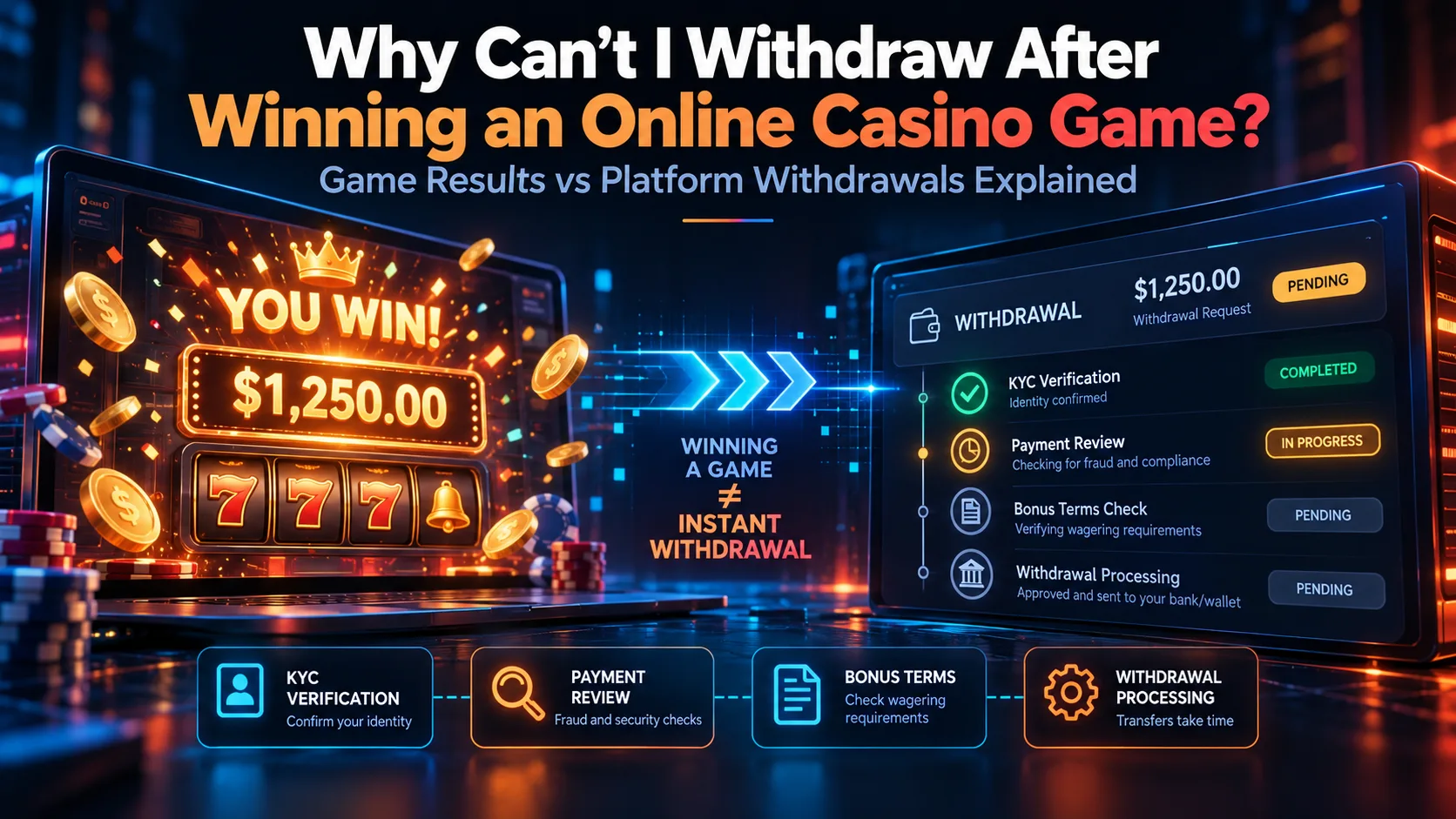
You win an online casino game.
The game shows the result. The balance increases. Everything appears finished.
Then you try to withdraw the money — and suddenly the process stops.
The platform asks for identity documents, says the withdrawal is under review, mentions bonus conditions, rejects the payment method, or simply leaves the request pending.
That can immediately create one question:
If the game already says I won, why can’t I withdraw the money?
The answer is that a game result and a platform withdrawal are two separate processes.
A game provider may determine and settle the result of a round, while the casino operator handles your account, wallet, identity verification and withdrawal request.
Understanding that distinction makes withdrawal problems much easier to investigate.
Winning the Game and Withdrawing the Money Are Not the Same Process
When a game ends with a winning result, the game system normally reports that result back to the platform.
The platform then updates the player’s account balance according to the transaction.
But that does not automatically mean the money has already left the casino and entered your bank account or payment wallet.
A simplified flow looks like this:
Game result → Account balance → Withdrawal request → Platform checks → Payment processing
Each stage can involve a different system.
This is why a completed game result can be completely valid while the withdrawal is still pending.
The question has changed.
It is no longer:
“Did I win the game?”
It becomes:
“Will the platform process my balance and withdrawal correctly?”
Who Is Responsible for the Game Result?
Online casinos often offer games supplied by external game providers.
The provider may be responsible for the actual game software, mathematics, RNG or fairness system, game server and round records.
The casino operator provides the platform around that game.
This can include the player account, wallet, deposits, withdrawals, promotions and customer support.
That distinction is important.
If a slot, crash game, Mines-style game or another electronic game produces a valid winning result, the underlying game provider may already have completed its job.
A later withdrawal problem does not automatically mean that the original game result was manipulated.
It may instead be a problem involving the casino platform.
Who Is Responsible for the Withdrawal?
Withdrawals are normally handled by the casino operator, not by the individual game shown inside the casino lobby.
The operator may need to deal with account verification, payment providers, transaction monitoring and other compliance requirements before sending funds.
For example, a platform may need to confirm that the account belongs to the person requesting the withdrawal.
It may also need to investigate unusual account activity or confirm that the payment information is valid.
So when a game displays a winning multiplier or payout, the game provider does not usually control whether your bank transfer, UPI payment or wallet withdrawal is approved later.
Those are different systems.
Why Can a Withdrawal Be Delayed?
A delayed withdrawal does not automatically mean the player has been cheated.
There can be legitimate reasons for a withdrawal to require additional processing.
One common reason is identity verification, usually referred to as KYC — Know Your Customer.
A platform may need to verify details such as a player’s identity, age, address or payment information.
There may also be fraud-prevention or anti-money-laundering checks when account activity appears unusual.
Payment processing can create another delay.
A casino may approve a withdrawal internally, but the payment provider, bank or wallet still needs to process the transaction.
Different payment methods can therefore have different processing times.
The important question is not simply whether a withdrawal takes time.
It is whether the platform provides a clear reason, follows its published terms and handles the request consistently.
KYC Should Not Be Confused With a Losing Game
Imagine that you play a casino game and win.
The round is complete.
Your balance shows the money.
When you request a withdrawal, the platform asks you to verify your identity.
That does not mean the game result has changed.
The game may already have been settled correctly.
The platform is now performing an account-level check.
These are separate events.
This distinction matters because players sometimes interpret every withdrawal delay as evidence that the game itself was fake.
That may happen in some fraudulent situations, but a withdrawal check alone does not prove it.
You need to identify which part of the system is actually causing the problem.
But Can a Platform Abuse KYC to Delay Withdrawals?
This is where things become more complicated.
Identity verification can be legitimate, but that does not mean every request for documents is automatically reasonable.
For example, regulatory standards in Great Britain require licensed remote gambling businesses to verify key customer identity information before allowing customers to gamble.
The UK Gambling Commission also states that a withdrawal request should not suddenly trigger requests for information that the operator could reasonably have requested earlier.
There can still be cases where additional information is legitimately required later, such as when unusual account activity creates a new legal or fraud-related concern.
This provides a useful principle even outside that specific regulatory market:
KYC should be a genuine verification process, not an excuse that appears only when a player tries to take money out.
Rules differ between countries and regulatory systems, so players should always check the requirements that apply to the platform they are using.
What About Bonus Terms?
Bonuses create another source of confusion.
A casino may display promotional credit or bonus-related funds inside the player account, but those funds may not always have the same withdrawal status as deposited or unrestricted cash.
Depending on the promotion and platform, a bonus may have conditions attached to it.
For example, a promotion may define eligible games, wagering conditions, maximum stakes or other rules that affect when promotional funds become withdrawable.
That is why players should check the actual terms before using a bonus, not only after requesting a withdrawal.
However, bonus terms and game results should again be separated.
A valid game result can exist while a bonus condition still affects which part of an account balance is currently withdrawable.
That is a platform and promotion issue, not necessarily evidence that the underlying game was unfair.
What If the Platform Says My Account Activity Is Under Review?
Account reviews can happen when a platform detects activity that appears unusual.
That might include sudden changes in betting behaviour, payment inconsistencies, possible account sharing, identity concerns or transaction patterns requiring additional investigation.
A review does not automatically mean wrongdoing occurred.
But the quality of the operator matters.
A trustworthy platform should have a clear process for explaining what information is needed and what the player needs to do next.
An indefinite delay with vague explanations is very different from a clearly documented verification process.
This is one reason platform research should include more than just welcome bonuses or the number of games available.
Withdrawal rules, KYC requirements, support quality and account terms can matter just as much as the game library.
Can the Game Provider Help With a Withdrawal Problem?
Usually, this is limited.
The game provider and the casino operator may have very different responsibilities.
If the problem involves the actual result of a game round — for example, a disputed round history or missing game settlement — the provider’s game records may be relevant.
But if the issue is:
“My casino balance is correct, but the platform will not process my withdrawal,”
the problem is generally on the operator side.
Contacting the game developer may therefore not solve an account or payment dispute.
This is another reason players should know whether they are dealing with a game problem or a platform problem.
A Valid Game Does Not Automatically Mean a Good Casino
This is one of the most important distinctions in online gaming.
A casino can offer a genuine game from a recognised provider and still provide a poor overall platform experience.
For example, the game itself could operate according to its published rules while the operator has slow support, confusing bonus terms or difficult withdrawal procedures.
The opposite concern can also exist.
A professional-looking website may have fast customer service and attractive promotions, but that alone does not prove every game displayed on the site is genuine.
So there are two separate questions:
Is the game legitimate and operating correctly?
And:
Is the platform trustworthy with accounts and payments?
Players should investigate both.
What If My Withdrawal Is Rejected?
A rejected withdrawal needs a specific explanation.
Do not assume immediately that the game result was cancelled.
Check what the platform actually says.
The rejection may relate to incomplete KYC, incorrect payment details, unsupported withdrawal methods, bonus conditions, account restrictions or another platform rule.
Then compare that explanation with the terms that were available when the account was created or the promotion was accepted.
If the platform is regulated, you may also be able to use its formal complaints or dispute process.
The important point is to preserve evidence.
Keep screenshots of the game result, balance, withdrawal request, transaction history, support messages and any relevant terms.
That creates a much clearer record than simply stating that money disappeared.
What If the Platform Keeps Asking for More Documents?
Some verification requests may be legitimate.
But repeated requests without a clear explanation deserve closer attention.
Ask exactly what remains unverified.
Check whether the platform explains why the document is required.
Confirm that you are communicating through the genuine platform and not through a fake support account.
Never send passwords, OTP codes or sensitive payment credentials to random contacts claiming that they can “unlock” a withdrawal.
Withdrawal problems are also commonly used as a social-engineering opportunity.
Someone may pretend to be support and ask for another payment, an OTP or remote access to your device.
A genuine withdrawal dispute should not become an excuse to ignore basic account-security practices.
Can a Casino Refuse to Pay Simply Because You Won Too Much?
A legitimate platform should not simply turn a valid winning balance into a non-payable balance because the player happened to win.
That does not mean every withdrawal request must be processed instantly.
Legitimate account, payment, fraud or regulatory checks can still occur.
But there is a major difference between:
“We need to complete a specific verification check.”
and:
“You won too much, so we are not paying.”
Players should expect clear rules and clear explanations.
For example, UK Gambling Commission guidance states that licensed operators should not hold customer money unnecessarily and that customers should be able to withdraw funds without unreasonable delay or restriction.
Those rules apply specifically to operators under that regulatory system, but they illustrate why withdrawal procedures are an important part of evaluating a platform.
Is a Withdrawal Problem Proof That the Game Is Rigged?
No.
A withdrawal dispute and a manipulated game result are not the same allegation.
Suppose a player wins a round of Aviator, a slot game, Mines or another electronic casino game.
The winning round appears correctly in the history and the balance is credited.
Later, the withdrawal becomes stuck because of KYC.
That evidence points toward an account or platform issue — not necessarily the game result.
If the round itself is missing, the balance was never credited, or the recorded outcome differs from what the player saw, then the game or transaction record becomes more relevant.
Identifying where the failure occurred is the first step toward understanding the problem.
A Simple Way to Diagnose the Problem
Start with the game record.
Was the winning round recorded correctly?
Then check the account balance.
Was the payout credited?
Next, check the withdrawal request.
Was it accepted, rejected or marked as pending?
After that, identify the exact reason given by the operator.
This creates a simple chain:
Game result → Credit to balance → Withdrawal request → Verification → Payment
Wherever that chain stops is where you should investigate first.
This is much more useful than treating every payment problem as proof that the electronic game itself was manipulated.
Game Fairness and Payment Reliability Need Different Checks
Aviator21 separates these areas for a reason.
Game research can examine mechanics, RNG, RTP, Provably Fair systems and whether a game appears to be the genuine provider version.
Platform research needs to examine different issues.
Those include account rules, KYC, deposits, withdrawal conditions, payment options, support and regional availability.
A platform can score well in one area and poorly in another.
That is why simply asking:
“Does this casino have Aviator?”
is not enough.
The better questions are:
Is it the genuine game?
How does the platform handle player accounts and withdrawals?
Are the rules clearly explained before money is deposited?
Final Answer: Why Can’t I Withdraw After Winning?
Winning an online casino game does not automatically complete the withdrawal process.
The game result determines whether the round won or lost.
The casino operator then manages the player account, balance, verification and withdrawal.
A delay can therefore happen even after a completely valid winning result.
Possible reasons include KYC, payment processing, unusual account activity, bonus conditions or account-level restrictions.
But legitimate verification should not become a permanent excuse for withholding money without explanation.
Players should separate the two issues:
Game result: Was the round generated and settled correctly?
Platform withdrawal: Is the operator processing the account and payment correctly?
Once those questions are separated, it becomes much easier to identify whether the real problem is the game, the casino platform or the payment process.
FAQ
Why does my casino balance show winnings but I still cannot withdraw?
The game may already have settled the winning result, while the platform is still processing the withdrawal. Account verification, payment checks or other platform requirements can happen after the result has been credited.
Can a casino ask for KYC before paying winnings?
Platforms may need to perform identity and compliance checks. The exact requirements depend on the operator and jurisdiction. However, verification requirements should be clearly communicated and should not simply become an unexplained obstacle when a player requests a withdrawal.
Does a withdrawal delay mean the casino game was fake?
No. A withdrawal delay is primarily an account or payment issue. You would need separate evidence to conclude that the underlying game result was manipulated or fake.
Can bonus money affect withdrawals?
Yes. Promotional funds can have separate terms that determine when or how they become withdrawable. Players should check the conditions of a promotion before accepting or using it.
Is the game provider responsible for paying my withdrawal?
Usually not. A game provider may supply the game and determine or record game outcomes, while the casino operator manages player balances, accounts and withdrawals.
What should I save if I have a withdrawal dispute?
Keep the game history, account balance, withdrawal status, transaction records, relevant bonus terms and communication with customer support. These records help identify where the problem actually occurred.
Is KYC always proof that the casino is delaying payment intentionally?
No. KYC can be a legitimate identity or compliance process. The warning sign is not verification itself, but unclear, inconsistent or repeatedly changing requirements with no reasonable explanation.